
Navigating the Lifelines: A Guide to Dialysis and Kidney Transplant in India
For someone living with Chronic Kidney Disease (CKD), the journey can be a path of gradual changes. When kidney function declines to a critical point (often Stage 5 CKD or End-Stage Renal Disease – ESRD), the kidneys can no longer perform their life-sustaining functions. At this crucial juncture, two primary “lifelines” become available: Dialysis and Kidney Transplant. Understanding these options is key to making informed decisions for a healthier future.


Dialysis: A Bridge for Your Kidneys
Imagine your kidneys are like a natural purification system for your body. When they fail, dialysis steps in as an artificial way to perform these essential functions – removing waste products and excess fluid from your blood. There are two main types of dialysis available in India:
Hemodialysis (HD): The External Cleanse
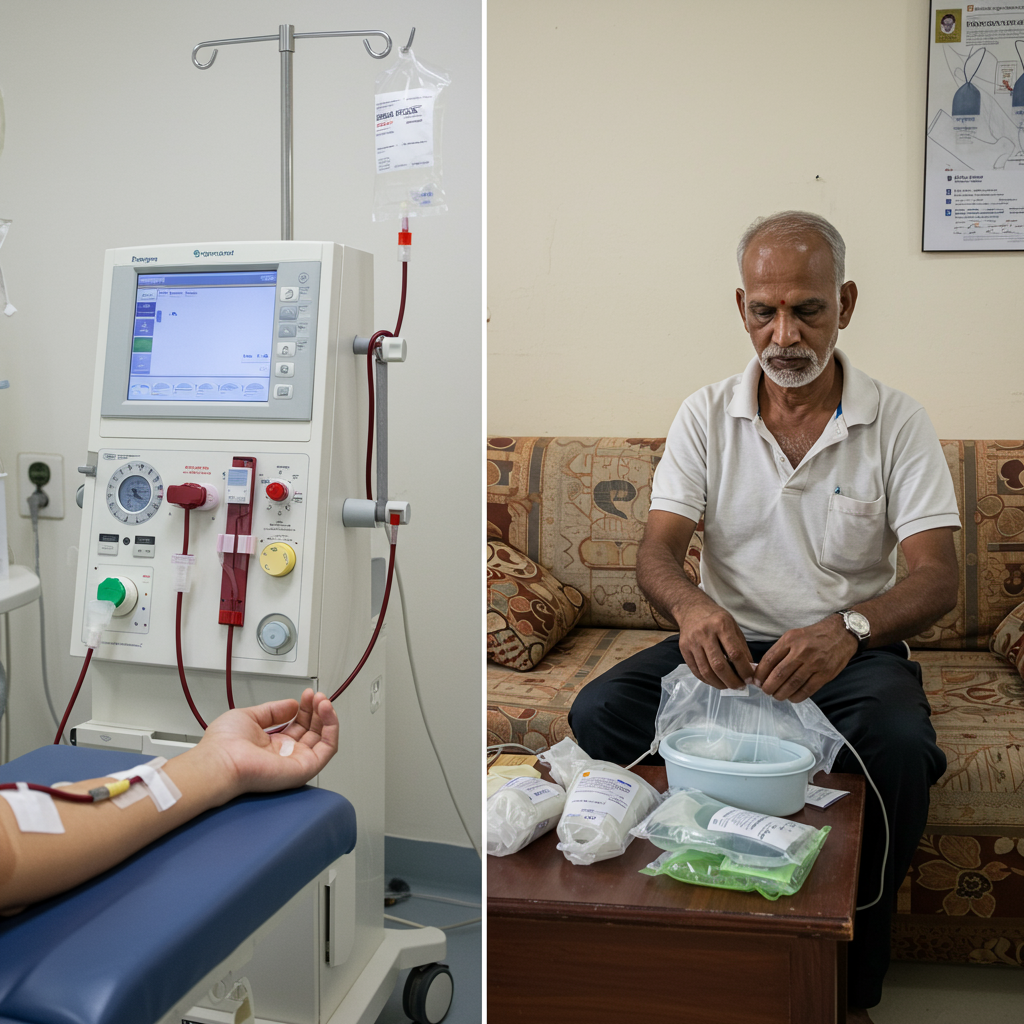
How it Works: In hemodialysis, your blood is circulated outside your body, through an artificial kidney machine called a dialyzer. This machine filters your blood, much like your own kidneys would, and then returns the cleaned blood to your body.
The Experience: Typically, hemodialysis is performed in a hospital or a specialized dialysis centre. Sessions usually last about 3-4 hours and are done 2-3 times a week. Before starting, a vascular access (like a fistula or graft, often in the arm) is created to facilitate blood flow to and from the machine.
Considerations in India: Dialysis centres are becoming more accessible in major cities, but challenges can include travel to centres, the time commitment, and managing the cost, though government schemes and insurance are increasingly offering support. For many, it offers a structured routine and professional medical supervision.
Peritoneal Dialysis (PD): The At-Home Advantage
How it Works: Peritoneal dialysis uses the lining of your abdomen (peritoneum) as a natural filter. A special fluid is introduced into your abdominal cavity through a permanent tube (catheter) surgically placed in your abdomen. This fluid absorbs waste products and excess fluid from your blood, and then it’s drained out.
The Experience: The beauty of PD is that it can often be done at home, giving you more flexibility. It can be done manually a few times a day (CAPD – Continuous Ambulatory Peritoneal Dialysis) or by a machine overnight (APD – Automated Peritoneal Dialysis). Training is provided to you and your family to manage the process safely.
Considerations in India: PD offers more independence and avoids frequent hospital visits, which can be a significant advantage in areas with limited access to HD centres. However, it requires strict hygiene practices at home to prevent infections, and space for storing supplies.
Kidney Transplant: The Gift of a New Beginning
While dialysis sustains life, a kidney transplant often offers the best chance for a full and active life. It’s a surgical procedure where a healthy kidney from a deceased or living donor is placed into your body to take over the work of your failed kidneys.
The Process: Finding a suitable donor is the first step. This can be a living donor (a family member or close friend who is a match) or a deceased donor (from someone who has pledged their organs). Once a match is found and all medical evaluations are complete, the transplant surgery takes place.
Post-Transplant Life: After a successful transplant, you’ll need to take immunosuppressant medications for life to prevent your body from rejecting the new kidney. Regular follow-ups with your medical team are crucial.
Considerations in India: India has a growing transplant program, particularly in metropolitan areas. However, challenges include the waiting list for deceased donors, the complexity of finding compatible living donors, and the significant financial commitment involved (though government and charitable organizations offer support). The emotional journey for both recipient and donor families is also a significant aspect.
Making the Choice: A Collaborative Decision
The decision between dialysis and transplant is deeply personal and complex. It involves discussions with your nephrologist, family, and sometimes a transplant coordinator. Factors like your overall health, lifestyle, financial situation, and emotional readiness all play a role. Both options are lifelines, offering hope and extending the possibility of a fulfilling life with kidney disease. The key is to understand each path and choose the one that aligns best with your needs and circumstances.